Knowing flower names is one thing. Knowing how to say them, what they actually mean, and exactly when to use them is something else entirely. This comprehensive reference guide gives you everything in one place: pronunciation, symbolic meaning, seasonal availability, vase life, and the occasions each flower is best suited for.
Whether you're planning a gift, building an arrangement, or simply trying to communicate confidently with a florist, this guide has you covered.
The Complete Flower Name Reference Guide
Rose (pronounced: ROHZ)
Latin name: Rosa
Colour range: Every colour except true black and true blue
Season: Year-round
Vase life: 7–14 days (with proper care)
Symbolic meaning: Love, passion, admiration (varies by colour: red = love, pink = admiration, white = purity, yellow = friendship, orange = enthusiasm)
When to use:
- Red roses: Valentine's Day, anniversaries, declarations of love
- Pink roses: birthdays, thank-you gifts, Mother's Day
- White roses: weddings, sympathy, new beginnings
- Yellow roses: friendship, congratulations, get-well
- Mixed: any occasion
Florist communication tip: Ask specifically for "garden roses" (David Austin varieties) if you want high petal count and fragrance. "Standard roses" or "commercial roses" are the typical long-stem florist variety with 15–25 petals.
Pronunciation notes: ROHZ. One syllable. The plural is ROH-zez. "Rosé" (the wine) is different: roh-ZAY.
Tulip (pronounced: TOO-lip)
Latin name: Tulipa
Colour range: Every colour including near-black; parrot, double, and fringed varieties available
Season: January through May (peak March–April)
Vase life: 7–10 days
Symbolic meaning: Perfect love, elegance, grace. Each colour has distinct meaning: red = declaration of love, purple = royalty, yellow = cheerful thoughts, white = forgiveness.
When to use:
- Spring birthdays and celebrations
- Congratulations and new beginnings
- Everyday gifting during spring season
Shopping tip: Buy tulips in bud form (partially or fully closed). They will open beautifully in the vase over 2–3 days, giving you the longest display. Fully open tulips at point of purchase will last only 3–5 days.
Pronunciation notes: TOO-lip. Two syllables. Common mispronunciation: "TYOO-lip" is technically British English; "TOO-lip" is standard American English.
Lily (pronounced: LIL-ee)
Latin name: Lilium
Colour range: White, pink, orange, red, yellow (Asiatic); white, pink, rose (Oriental)
Season: Spring through fall; year-round from florists
Vase life: 10–14 days (multiple buds open sequentially)
Symbolic meaning: Purity, innocence, spiritual peace (white); prosperity, romance (pink); energy, passion (orange)
When to use:
- White lilies: sympathy, memorial occasions, religious celebrations (Easter)
- Pink/coral lilies: weddings, romantic occasions, celebratory gifts
- Orange lilies: bold, energetic arrangements, summer celebrations
Care warning: Remove pollen-bearing anthers as blooms open. Lily pollen stains fabric and clothing permanently and with great difficulty even a brush of a sleeve against an open lily can cause permanent staining.
Pronunciation notes: LIL-ee. Two syllables. "Lilly" (with double L) is a common misspelling the flower has a single L.
Orchid (pronounced: OR-kid)
Latin name: Orchidaceae (family); Phalaenopsis (most common type)
Colour range: White, pink, purple, yellow, orange, green, brown, bicolour widest colour range of any flower
Season: Year-round (greenhouse grown)
Vase life: As potted plant: 2–4 months blooming; as cut flower (cymbidium): 3–4 weeks
Symbolic meaning: Luxury, beauty, strength, love, refinement, rare beauty
When to use:
- Luxury gifting (anniversaries, milestone birthdays, corporate)
- Home decor (as a potted plant)
- Wedding floristry (cymbidium orchids as accent pieces)
Shopping tip: The most common orchid mistake is overwatering. Phalaenopsis orchids need just 1/4 cup of water per week or 3 ice cubes. More water = root rot. Less water = they're fine, they evolved in environments with irregular rainfall.
Pronunciation notes: OR-kid. Two syllables. NOT "or-CHID." The "ch" is silent in the standard pronunciation.
Peony (pronounced: PEE-oh-nee)
Latin name: Paeonia
Colour range: White, cream, blush, pink, coral, magenta, deep red. No blue or yellow.
Season: Late April through June (very brief)
Vase life: 5–7 days at full bloom; 10+ days from tight bud to end of display
Symbolic meaning: Romance, prosperity, honour, good fortune; love and nobility (China)
When to use:
- Wedding floristry (the most sought-after wedding flower)
- Romantic occasions (anniversaries, Valentine's Day)
- Spring and early summer gifting when available
Buying tip: Always buy peonies in tight bud form they should feel like firm marbles with petals just beginning to show. This gives you the full experience of watching them open AND the maximum display time. Fully open peonies at a florist are already near the end of their vase life.
Pronunciation notes: PEE-oh-nee. Three syllables. Named after Paeon, the physician of the Greek gods. Common mispronunciation: "PAY-oh-nee." The correct first syllable sounds like the letter P + "ee."
Sunflower (pronounced: SUN-flow-er)
Latin name: Helianthus annuus
Colour range: Yellow (classic), orange, deep red, bicolour, chocolate-brown speciality varieties
Season: June through October naturally; year-round (smaller sizes) from greenhouses
Vase life: 10–12 days
Symbolic meaning: Adoration, loyalty, long life, happiness, optimism
When to use:
- Birthdays (universally appropriate, any age, any gender)
- Get-well arrangements (uplifting and cheerful)
- Congratulations (celebratory energy)
- Summer events and outdoor celebrations
Care tip: Sunflowers are high-water-consumption flowers. Check water daily and top up as needed. Remove any leaves that fall below the waterline, as they rot quickly and contaminate the water.
Pronunciation notes: SUN-flow-er. Three syllables. Universally known no pronunciation variations.
Carnation (pronounced: kar-NAY-shun)
Latin name: Dianthus caryophyllus
Colour range: Every colour including bicolour and picotee (petals with differently coloured edges)
Season: Year-round
Vase life: 14–21 days (longest of any common cut flower)
Symbolic meaning: Love, admiration, good luck (varies by colour: red = deep love, white = pure love, yellow = disappointment avoid for romantic gifts)
When to use:
- Any occasion (most versatile flower for everyday use)
- Large arrangements and events (best value-to-impact ratio)
- Long-lasting gifts (will outlast most other cut flowers)
Common misconception: Carnations are frequently dismissed as "cheap" or "unromantic." This perception is outdated. Professional florists and event designers use carnations extensively in premium installations precisely because their quality is genuine and their value exceptional.
Pronunciation notes: kar-NAY-shun. Three syllables. Stress on the second syllable. Common mispronunciation: "kar-nay-SHUN" (stress on last syllable).
Hydrangea (pronounced: hy-DRAN-jee-uh)
Latin name: Hydrangea macrophylla
Colour range: Blue, pink, purple, white, green, lime green and famously, the colour changes based on soil pH
Season: June through October; year-round from florists
Vase life: 7–10 days (wilt quickly when dehydrated see care tip)
Symbolic meaning: Gratitude, understanding, heartfelt emotion, abundance
When to use:
- Large arrangements and centrepieces (exceptional volume per stem)
- Wedding reception tables (most cost-effective flower for large-scale floral coverage)
- Summer and fall gifting
Critical care tip: Hydrangeas wilt faster than almost any other cut flower when dehydrated. If yours wilt before their time, submerge the entire flower head in cool water for 30 minutes they will revive dramatically. Also, cut the stems at an extreme angle (almost horizontal) to maximise water uptake surface area.
Pronunciation notes: hy-DRAN-jee-uh. Four syllables. Stress on the second syllable. The second "h" is silent. Common mispronunciation: "HY-dran-ja" (missing the extra syllable at the end).
Lavender (pronounced: LAV-en-der)
Latin name: Lavandula angustifolia
Colour range: Purple, violet, blue-purple, white, pink
Season: Fresh: June–August. Dried: year-round.
Vase life: 7–10 days fresh; indefinite dried
Symbolic meaning: Calm, devotion, purity, serenity, healing, love (English folk tradition)
When to use:
- Home fragrance and atmosphere
- Gifts for wellness, relaxation, and self-care enthusiasts
- Dried arrangements (lavender is one of the most beautiful dried flowers)
- As a fragrant addition to fresh bouquets
Fragrance note: Lavender's calming scent has been validated in clinical studies. Lavender essential oil (inhaled) showed anxiety-reducing effects comparable to pharmaceutical anxiolytics in some trials which is why it's the most widely used flower in aromatherapy.
Pronunciation notes: LAV-en-der. Three syllables. Stress on the first syllable. The lavender colour (pale purple) is named after the flower, not the other way around.
Chrysanthemum (pronounced: kreh-SAN-theh-mum)
Latin name: Chrysanthemum
Colour range: Every colour except blue; extraordinary variety of forms (pompon, disbud, spider, spray)
Season: Fall peak (September–November); year-round potted
Vase life: 14–21 days (tied with carnations for longest vase life)
Symbolic meaning: Longevity, joy, fidelity; imperial significance in Japan; used for sympathy in some European cultures
When to use:
- Fall arrangements (most iconic fall flower after autumn leaves)
- Sympathy (long-lasting and dignified)
- Budget-conscious occasions requiring long-lasting flowers
- Potted gifts (fall porch and home decor)
Spelling tip: Chrysanthemum is the most commonly misspelled flower name in the English language. Break it into parts: chrys (gold in Greek) + anth (flower) + emum. Or remember: "CHRYS-ANTH-EMUM."
Pronunciation notes: kreh-SAN-theh-mum. Five syllables. Stress on the second syllable. Common shortening: "mum" (British English) or "mum/mom" (American English for the plant). Both are widely accepted.
Flower Colour Meanings: Complete Guide
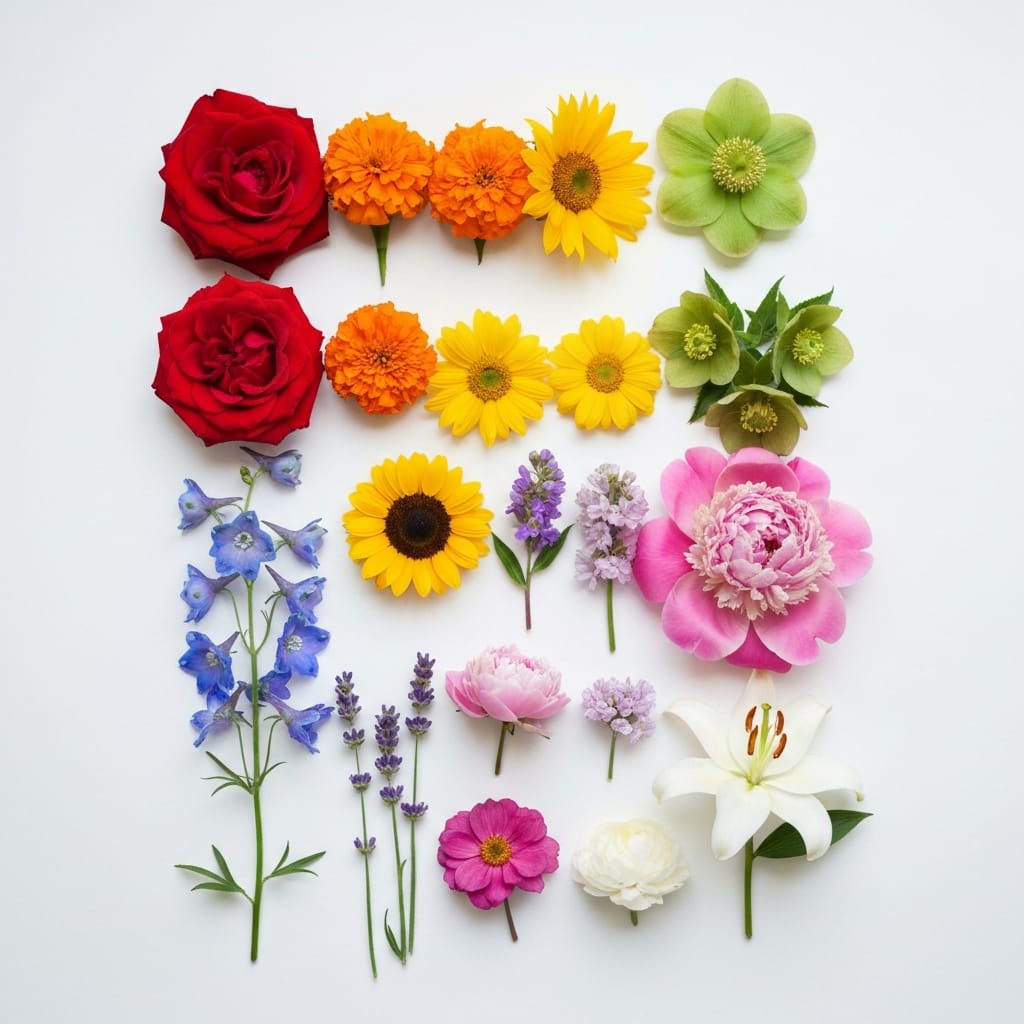
Colour meaning is one of the most powerful and underused tools in flower gifting. The same flower in different colours carries entirely different messages:
| Colour | Core Meaning | Occasions to Use | Occasions to Avoid |
|---|---|---|---|
| Red | Passionate love, courage, respect | Romantic occasions, Valentine's | Sympathy (too vibrant) |
| Deep pink | Gratitude, appreciation, admiration | Thank you, birthdays | None |
| Light pink | Grace, innocence, admiration | Birthdays, Mother's Day | None |
| White | Purity, new beginnings, sympathy | Weddings, sympathy, religious | Can feel clinical if only white |
| Yellow | Friendship, happiness, warmth | Birthdays, get-well, friendship | Romantic occasions (can mean jealousy) |
| Orange | Energy, enthusiasm, desire | Celebrations, bold statements | Sympathy |
| Purple | Royalty, admiration, enchantment | Luxury gifting, romantic | None |
| Blue | Tranquility, peace, rare beauty | Unique gifts, home decor | None |
| Green | Growth, harmony, health | New beginnings, houseplants | None |
| Peach | Gratitude, sincerity, modesty | Thank you, everyday gifting | None |
Seasonal Quick Reference
| Season | Best Available Flowers |
|---|---|
| Winter (Dec–Feb) | Roses, carnations, amaryllis, hellebores |
| Spring (Mar–May) | Tulips, peonies, ranunculus, sweet peas, daffodils |
| Summer (Jun–Aug) | Sunflowers, dahlias, lavender, hydrangeas, zinnias |
| Fall (Sep–Nov) | Dahlias, chrysanthemums, marigolds, dried flowers |
How to Use This Guide When Visiting a Florist
- 1Know your occasion and the colour message you want to send
- 2Ask the florist what is freshest in stock that day (within 24 hours of delivery)
- 3Choose your focal flower (rose, peony, lily), secondary (carnation, spray rose), and greenery (eucalyptus, ruscus)
- 4Tell the florist your budget upfront they can create something beautiful in every price range
Frequently Asked Questions
Quick answers to common questions


