
Starting with flowers can feel overwhelming. There are over 400,000 plant species. But here's the truth: you only need to know 10 to understand 90% of what you'll encounter at any US florist, grocery store floral section, or garden centre. These 10 flowers are the foundation of the entire American cut flower industry.
This guide gives every beginner the complete picture on each of these essential flowers: what they look like, what they mean, when they're in season, how long they last, and what to use them for. By the time you finish reading, you'll walk into any florist with confidence.
Why These 10 Flowers?
These 10 flowers were selected based on three criteria: commercial importance (they account for the majority of US cut flower sales), year-round availability or reliable seasonal supply, and universal recognition across virtually all demographics and cultural contexts.
Learn these 10 and you'll be able to name most flowers you encounter, understand what you're buying when you shop at a florist, and communicate clearly about what you want in an arrangement.
The 10 Flower Names Every Beginner Should Know
1. Rose (Rosa)
What it looks like: Typically the most recognisable flower in the world. A rose has tightly spiralled, overlapping petals in a conical or globular form. Standard commercial roses have 15–25 petals; garden roses have 40–100+. Stems are upright with thorns and dark green, compound leaves.
Colours available: Every colour except true black and true blue. Red, pink, white, yellow, orange, peach, lavender, and bicolours are all commonly available.
What it means: Red = passionate love. Pink = admiration, gratitude. White = purity, sympathy. Yellow = friendship, joy. Orange = enthusiasm, desire.
Season: Year-round (roses are the most consistently available cut flower in the US).
Vase life: 7–14 days with proper care (clean vase, trimmed stems, cool location, flower food).
Best for: Every occasion. Roses are the default gifting flower of the Western world.
Beginner tip: The most common beginner mistake with roses is not trimming the stems under water. Always cut 2 cm off the stem under running water before placing in the vase this prevents air bubbles from blocking water uptake.
2. Tulip (Tulipa)
What it looks like: An unmistakable cup or goblet shape on a single, upright stem. Petals are smooth and waxy. The classic tulip has 6 petals, though parrot and double varieties are more complex.
Colours available: Virtually every colour including near-black and multi-coloured varieties. The colour range of tulips rivals roses.
What it means: Red = declaration of love. Pink = caring. Yellow = cheerful thoughts. White = forgiveness, new beginnings. Purple = royalty.
Season: Late winter to spring (January through May in most of the US).
Vase life: 7–10 days.
Best for: Spring celebrations, birthdays, everyday gifting.
Beginner tip: Tulips keep growing after cutting, adding 2–3 inches to their height in the vase. Buy them in a slightly closed bud stage for the longest display they'll open beautifully over 2–3 days.
3. Lily (Lilium)
What it looks like: Large, trumpet or star-shaped blooms with 6 petals (technically 3 petals and 3 sepals, but visually identical). Multiple buds on each stem open sequentially. The most dramatic-looking common flower available.
Colours available: White, pink, orange, red, yellow (Asiatic); white, pink, deep rose with speckling (Oriental).
What it means: White lily = purity, spiritual peace, sympathy. Pink lily = prosperity, romance. Orange lily = energy, passion.
Season: Spring through fall; year-round from florists using greenhouse growing.
Vase life: 10–14 days (each stem's buds open over about a week).
Best for: Sympathy, weddings, formal occasions, any impressive gift.
Beginner tip: Remove the pollen-bearing anthers from lily flowers as they open. Lily pollen stains fabric permanently and with great difficulty. Gently pinch and remove anthers before they release pollen.
4. Sunflower (Helianthus annuus)
What it looks like: An enormous, circular flower head (6–12 inches across) with bright yellow ray petals surrounding a dense brown or golden-yellow centre disc. Tall, thick stems with rough, hairy texture and large leaves.
Colours available: Classic yellow, plus orange, deep red, bi-colour (red/yellow), and unusual chocolate-brown specialty varieties.
What it means: Adoration, loyalty, happiness, long life.
Season: Summer through fall (June–October) naturally; year-round in smaller sizes from greenhouse production.
Vase life: 10–12 days.
Best for: Birthdays, get-well, congratulations, summer events, any occasion needing maximum cheer.
Beginner tip: Sunflowers are thirsty. Check water levels daily and top up as needed they drink significantly more than most other cut flowers.
5. Orchid (Orchidaceae)
What it looks like: Orchids have an unusual, asymmetrical flower structure with 3 petals and 3 sepals, one of which (the "lip") is distinctively shaped and often a different colour. Phalaenopsis (moth orchid) the most common type has arching stems with 8–15 open flowers simultaneously.
Colours available: White, pink, purple, yellow, orange, green, brown, and extraordinary bicolours and patterns. Orchids have the most diverse colour range of any flower family.
What it means: Luxury, beauty, strength, love, refinement.
Season: Year-round (most orchids are greenhouse-grown year-round).
Vase life: As a potted plant, 2–4 months of blooming; as cut flowers (cymbidium), 3–4 weeks in water.
Best for: Luxury gifting, anniversaries, corporate gifts, home decor.
Beginner tip: As a potted gift, orchids are lower maintenance than their exotic appearance suggests. Water once a week with 3 ice cubes or 1/4 cup of water and place in bright, indirect light.
6. Daisy (Gerbera jamesonii / Bellis perennis)
What it looks like: The archetypal flower form: ray petals radiating from a central disc. The common daisy is white with a yellow centre. Gerbera daisies are large (3–5 inches across) with vivid colour and a large button centre.
Colours available: White/yellow (common daisy); gerberas come in virtually every colour.
What it means: Innocence, purity, cheerfulness, loyal love.
Season: Gerberas year-round; wild daisies spring–summer.
Vase life: 10–14 days (gerberas are among the longest-lasting common cut flowers).
Best for: Children's gifts, birthdays, casual gifting, everyday cheer.
Beginner tip: Gerbera stems are prone to bacterial blockage at the cut end. Re-trim every 2 days and keep water very clean. Some florists place them in only 3–4 inches of water to prevent stem rot.
7. Carnation (Dianthus caryophyllus)
What it looks like: Ruffled, densely petalled blooms (20–35 petals with fringed edges) on straight stems with blue-green foliage and distinctive swollen stem nodes. Available in two forms: standard (one large bloom per stem) and spray (multiple smaller blooms per stem).
Colours available: Every colour including bicolour and picotee patterns (petals with differently coloured edges).
What it means: Varies by colour: red = deep love, white = pure love, pink = mother's undying love, yellow = disappointment (avoid for romantic gifts), purple = capriciousness.
Season: Year-round.
Vase life: 14–21 days the longest of any common cut flower.
Best for: Any occasion; especially good where longevity matters.
Beginner tip: Cut carnation stems between the nodes (the swollen joints) rather than through them. Cutting through a node can prevent water uptake. Always cut between nodes at a 45-degree angle.
8. Peony (Paeonia)
What it looks like: Enormous, densely petalled blooms (40–120+ petals in double varieties) in rich, layered forms. In bud, peonies look like tight spheres covered with papery green sepals. As they open, they reveal wave after wave of petals in a spectacular display that takes 3–5 days to complete.
Colours available: White, cream, blush, rose pink, coral, magenta, and deep red. No blue or yellow.
What it means: Romance, prosperity, honour, good fortune.
Season: Late April through June (very brief only 6–8 weeks per year in most regions).
Vase life: 5–7 days at full bloom; 10+ days from bud to end of display.
Best for: Weddings, romantic occasions, luxury gifting, spring celebrations.
Beginner tip: Buy peonies in tight bud form (marble-sized) for the longest display. Place in a warm room out of direct sun to encourage opening. If they open too slowly, place in slightly warmer water.
9. Lavender (Lavandula)
What it looks like: Narrow, silvery-grey stems topped with dense spikes of tiny purple/blue florets. Aromatic silver-green foliage. Dried lavender looks almost identical to fresh but maintains its scent for 1–2 years.
Colours available: Purple, violet, blue-purple, white (varieties), pink (varieties).
What it means: Calm, devotion, purity, serenity, healing.
Season: Fresh: June–August. Dried: year-round.
Vase life: 7–10 days fresh; indefinite dried.
Best for: Home fragrance, dried arrangements, calming gifts, spa/wellness contexts.
Beginner tip: To dry lavender, bundle 20–30 stems with a rubber band, hang upside down in a warm, dry location for 2–3 weeks. The dried lavender retains its colour and most of its fragrance and makes excellent sachets, wreaths, or decoration.
10. Chrysanthemum (Chrysanthemum)
What it looks like: An enormously diverse group. Pompon mums are perfectly round balls of tightly packed florets. Disbud mums have a single large bloom per stem. Spider mums have long, tubular petals radiating outward. Spray mums have multiple smaller blooms per stem.
Colours available: Every colour except blue. Yellow, white, orange, red, pink, purple, green, and extraordinary bicolours.
What it means: Longevity, joy, fidelity; imperial significance in Japanese culture.
Season: Peak fall (September–November); year-round as potted plants and from greenhouse growing.
Vase life: 14–21 days tied with carnations for longest vase life.
Best for: Fall arrangements, sympathy, long-lasting gifting, budget-conscious arrangements.
Beginner tip: Remove all foliage that would sit below the waterline before placing chrysanthemums in a vase. Their leaves rot quickly in water and significantly shorten vase life through bacterial contamination.
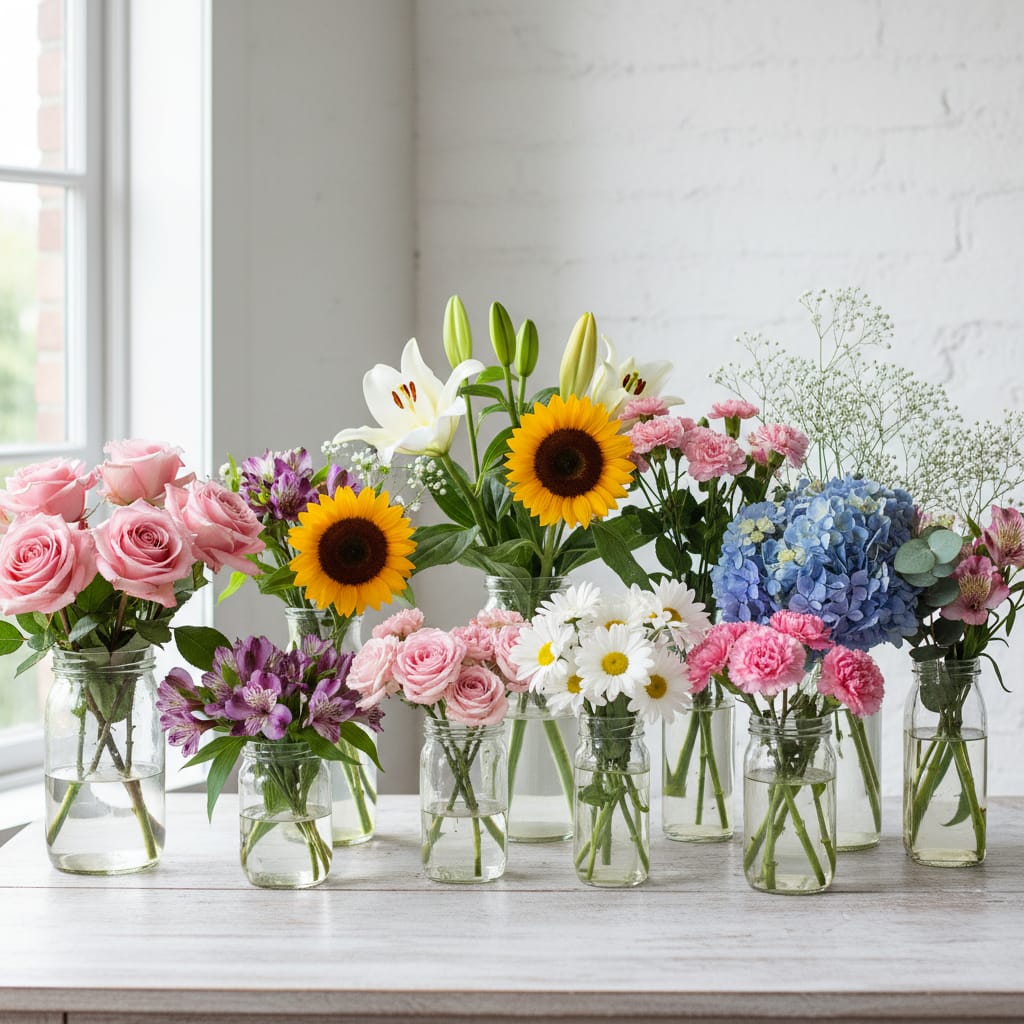
Putting It Together: The Beginner's Arrangement Guide
Now that you know these 10 flowers, here's how to use them in practical gifting and arranging:
For a Birthday Arrangement
Focal: Sunflowers or gerbera daisies
Secondary: Carnations or roses
Greenery: Eucalyptus
For a Wedding Bouquet
Focal: Peonies or garden roses
Secondary: Ranunculus or tulips
Filler: Sweet peas, wax flower, eucalyptus
For a Sympathy Arrangement
Focal: White lilies
Secondary: White carnations or chrysanthemums
Greenery: Italian ruscus or fern
For a Romantic Gift
Focal: Red or blush roses
Secondary: Lavender or spray roses
Greenery: Eucalyptus or ruscus
For Everyday Cheer
Focal: Tulips or gerberas
Secondary: Carnations
Greenery: Any available
Quick Reference: What to Buy for Each Occasion
| Occasion | First Choice | Alternative |
|---|---|---|
| Birthday | Sunflowers, gerberas | Mixed colourful bouquet |
| Anniversary | Roses, peonies | Orchids, garden roses |
| Sympathy | White lilies | White carnations |
| Wedding | Peonies, garden roses | Ranunculus, tulips |
| Just because | Tulips, carnations | Mixed bouquet |
| Thank you | Orchids, freesia | Yellow roses |
Frequently Asked Questions
Quick answers to common questions


